
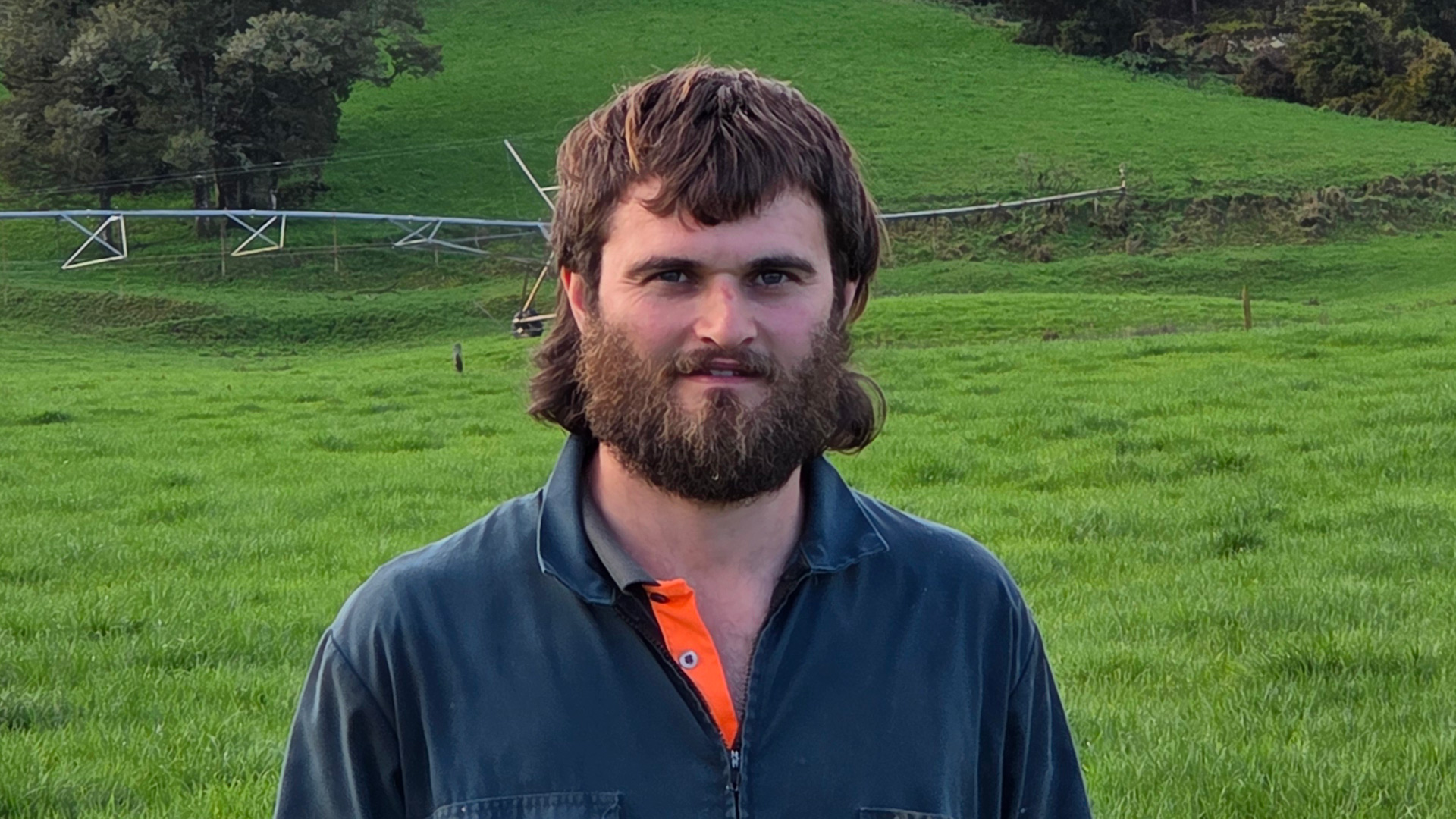
West Coast dairy farmer Brett McLennan is using AIMER to bring more confidence, consistency and forward planning to pasture management on his family’s farm.
Brett McLennan knows good pasture management is not always as simple as walking the farm, checking covers and making a grazing plan.
On his family’s dairy farm, 15 minutes south of Reefton, there are a few extra layers of complexity. A main highway cuts through the farm, so does the railway line to Westport, and there are rivers running through and around the property.
“No paddock is square, no paddock is rectangle, and no paddock is the same size,” says Brett. For a farmer who describes himself as a “stickler” for pasture management, that has always meant a lot of maths.
Brett is 50:50 sharemilking on his family’s farm, milking 570 cows this season on 199 hectares, with plans to drop to 550 cows next season. His aim is to keep lifting per cow production while staying efficient and keeping grass at the centre of his system.
“We should do about 530kgMS per cow this season, and we want to hit 550 next season, but we don’t want to keep buying in more feed to do it,” he says. “We still want to be grass-based. We’re already a System 5 farm, so we don’t want to keep blowing that out. We want to make sure we’re cost-effective.”
The farm’s performance is already moving in that direction. Aimer Farming’s analysis of Brett’s farm data suggests that, even after allowing for increased imported supplement, milksolids have lifted by about 5.4% since he started using AIMER. This season, production is also tracking 6.1% ahead of the same time last year, which was already a record season for the farm.
Picking up pasture changes faster
Before using AIMER, Brett was measuring pasture with a plate meter and completing whole-farm walks. A full walk took about two-and-a-half to three hours and covered 18 to 20 kilometres, depending on how much of the farm he could get around on the quad bike.
Brett has now used AIMER for around two-and-a-half seasons and says this is his first full season “100% relying on AIMER Vision.”
The biggest change has been the ability to measure more often, complete partial farm walks when needed and respond faster when conditions change. That matters on the West Coast, where growth rates can move quickly.
“One minute we’re too wet, then literally five days later we’re just perfect, and the grass has taken off,” says Brett. “With AIMER, I can do farm walks in quick succession or partial farm walks to see those changes. We can pick up that the growth rate has doubled from 50 to 100kgDM/ha/day in the last five days, and we’ve picked it up really quickly.”
That information gives Brett options. He can drop out supplementary feed from his herd’s diet, lock up grass for silage, or adjust his grazing plan before the opportunity is missed.
“I don’t have to allocate a full morning to it anymore,” he says. “I can pop out on farm at 11am, get back by lunchtime, and do some scenario planning while I have lunch.”
Taking the guesswork out of the grazing plan
For Brett, one of the most practical benefits of AIMER is scenario planning. In spring, decisions around how much area to cut for silage, whether to hold paddocks in the round, or how much supplement to feed used to involve a couple of hours with paper, pen and a calculator.
“It was a bit of a guessing game,” he says. Now, that planning takes Brett about half an hour in AIMER.
“AIMER’s optimisation is amazing. I can quickly work out how many paddocks to drop out for silage, or whether to add in supplement and how much, for my desired round length.”
The value is being able to run multiple scenarios before making a call. Brett can look at the pasture data, factor in the weather forecast, and compare different options.
“You can say, ‘I’m comfortable with scenario B or C,’ and drop those paddocks out for silage, knowing you’re not getting yourself into a deficit by cutting too much.”
Like many farmers, Brett needed to trust the technology before he fully let go of his old system. At the start of the season, he still carried the plate meter on the quad bike. If he was unsure about a reading from AIMER, he would pull it out and check.
“I wouldn’t even get a quarter of the way across the paddock before I’d walk back to the bike, because it was telling me exactly what AIMER was,” he says.
Since February, Brett has not taken the plate meter with him as part of his regular pasture measuring.
“The answer was always the same,” he says. “I’d get about five or six plonks in and turn back around and get back on my bike.”
Making the plan clearer for everyone
AIMER has also helped bring more clarity to Brett’s wider farm team, which includes two full-time staff and a casual.
Before AIMER, staff were often waiting on grazing decisions. Now, after a partial walk, Brett can create a grazing plan for the next 14 days. Staff can check the three-day grazing plan on their phones or view the 14-day plan on the computer in the cowshed. The plan also shows how much supplement needs to be fed for each break.
“They’d be constantly asking, ‘Where are the cows going tonight? How big is the break? How much supplement needs to be fed out?’” says Brett. “Now, a lot of that stress has gone away because it’s all pre-planned once a week.”
Brett spent 10 years farming in Southland before returning to the West Coast family farm, so he knows not every system or region is the same. On a farm where paddock size, shape, weather and growth rates can all be variable, he says AIMER has taken a lot of the manual calculation and uncertainty out of pasture management. Most importantly, Brett says, pasture still has to come first.
“Grass is still king. Everything else is just complementing it. There’s no point buying grain at $530 a tonne if you haven’t got the grass right.”
For Brett, AIMER is helping him get those basics right, faster and with more confidence.
“It saves me time and a lot of headaches,” he says. “The planning’s there, it’s simple for a manager or staff to use, and it just makes pasture management decisions so easy.”


